Germany to be urged to ease austerity during G8 talks as fears of global recession grow
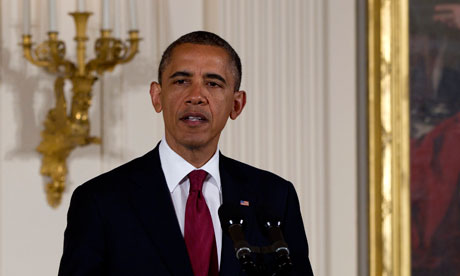
Barack Obama is to put pressure on Germany to ease the pain of austerity with policies to boost growth, as he uses two days of talks with the G8 industrial nations to warn Europe it needs to act swiftly to spare the world economy from a second deep recession in four years.
Ahead of the G8 summit, at Camp David this weekend, a warning from the ratings agency Fitch that Greece's days in the single currency could be numbered heightened fears in Washington that the worsening crisis in the eurozone poses a threat to America's fragile recovery and President Obama's re-election chances.
Obama will welcome the new French president, François Hollande, as a potential ally in his push for Europe to follow the US in giving a higher priority to expansionary policies, and as a counterweight to the German chancellor, Angela Merkel.
Obama can expect support from David Cameron, who told Merkel and Hollande on Thursday that eurozone leaders must embark on a series of urgent steps to prop up the single currency, to avoid a major implosion across the continent.
In a video conference with fellow EU leaders, the prime minister warned of a "remorseless logic" which dictates that struggling members of a single currency are supported by stronger members.
"The prime minister emphasised the importance of Greece and the eurozone taking decisive action to ensure financial stability and prevent contagion," a Downing Street spokesperson said. The video conference included Mario Monti, the Italian prime minister, José Manuel Barroso, the European Commission president, and Herman Van Rompuy, president of the European Council.
Nervous investors again turned to safe havens as they mulled the possibility of political chaos and economic collapse in Greece having knock-on effects for the global economy. Spain was the main focus of concern amid reports – denied by the economy minister – of a run on Bankia, the country's fourth-biggest bank. Fitch waited for European markets to close before downgrading Greece's credit rating from B- to CCC.
"The downgrade of Greece's sovereign ratings reflects the heightened risk that Greece may not be able to sustain its membership of economic and monetary union (EMU) ... In the event that the new general elections scheduled for 17 June fail to produce a government with a mandate to continue with the EU-IMF [International Monetary Fund] programme of fiscal austerity and structural reform, an exit of Greece from EMU would be probable," Fitch said.
Leaders of the west's most powerful economies have been meeting for informal talks every year since the oil shock of 1973 brought an end to the postwar boom, and while Obama is not anticipating any major decision to emerge from Camp David it will be a chance for the Americans to vent their frustration that Europe has failed to find a lasting solution to a debt crisis now in its third year.
A wave of downgrades of Spain's biggest banks was expected on Thursday night as another ratings agency, Moody's, downgraded four Spanish regions. It came after a day in which shares in Bankia at one point fell by 30% on reports that depositors were withdrawing their savings.
Bond yields rose amid fears, supported by PM Mariano Rajoy, that Spain would be frozen out of international markets and unable to raise funds.
In Greece, there were hopes that the deposit outflows from banks had reduced. But Stuart Gulliver, chief executive of Britain's biggest bank, HSBC, said: "We're in a worse place than we were a week ago. It remains a very difficult thing to call. I think the second [Greek] election in June will be a referendum on whether to stay in the euro. A month is a very long way away. We are now seeing price action that is consistent with capitulation."
Gulliver said if Greece left the eurozone, a firewall would need to be erected around Spain. If there was a run on banks in Greece, it might not be possible to wait for the elections on 17 June. He said his biggest worry "is absolutely how the eurozone plays out – whether Greece stays in, whether firewalls are high enough to protect Spain and, frankly, whether markets take things into their own hands before 17 June".
Alistair Darling, Labour's chancellor at the time of the collapse of Lehman Brothers, said: "From my own experience these things can blow up in a matter of hours. The slow bleeding of Greek banks should worry everyone. Europe for the last two years has been running round like headless chickens. It's no wonder people now think things will go wrong."