Move signals government's determination to press ahead with replacement programme for Trident nuclear missile system
The government will this week signal its intention to press ahead with a replacement programme for the Trident missile system with the announcement of £350m of contracts to start the initial design for the next generation of nuclear-deterrent submarines.
The announcement does not guarantee a decision in 2016 to go ahead with a full replacement, but it suggests Conservative ministers are keen to send a signal that they are not pulling back from the project.
There have been reports that a Ministry of Defence review led by the Liberal Democrat defence minister Nick Harvey will call for a scaled-down replacement, costing less than the estimated £20bn for a full replacement.
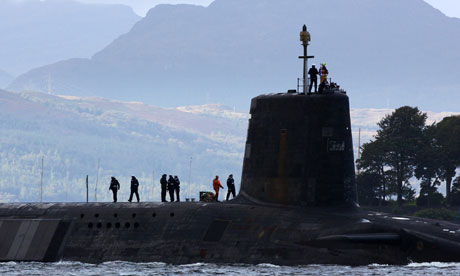
The new submarines are due to come into service in 2028, replacing the Vanguard-class submarines that currently carry the UK's nuclear deterrent. The subs will carry a new nuclear propulsion system that will make the craft more durable and cost-effective.
Government sources said this was "an important step towards renewing our nation's nuclear deterrent into the 2060s". It is expected that the contracts, which will be awarded exclusively to British companies, will sustain and create 1,900 jobs in the UK's submarine-building industry.
The Royal Navy has been operating continuous sea deterrent patrols for more than 40 years and the successor submarines will allow Britain to continue doing so well into the future with cutting-edge equipment.
The Liberal Democrats, though committed to keeping a nuclear deterrent, are examining different options. Instead of spending £20bn rebuilding Trident, they want to investigate whether cheaper alternatives – such as launching a warhead from aircraft or from Astute-class submarines – could be adopted.
The Vanguard submarines cannot be detected at sea and can launch missiles at a range of 6,000 miles. Astute-class submarines have to get closer to their target.
Harvey has argued that Britain's deterrent policy since the 1970s has been based on a principle that the nation would possess the nuclear capability to overwhelm opposing air defences and destroy an enemy government and military command centre. In Britain's case, the principal theoretical threat is still Moscow.
However, cabinet and defence officials are considering whether Britain's deterrent threat should be more limited, arguing that Britain could still inflict unacceptable damage on an enemy by wiping out smaller cities or military facilities. This would require less firepower, but it is arguable whether it would affect the choice of missile carrier.