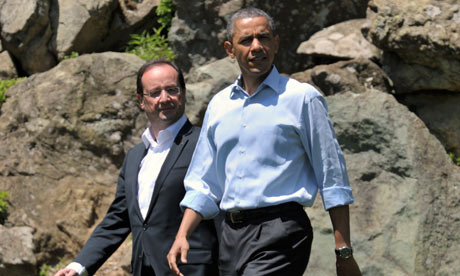
Barack Obama and David Cameron want German chancellor Angela Merkel to set out a clear path forward for Europe
Barack Obama and David Cameron on Saturday clashed with the German chancellor Angela Merkel, demanding she drop her G8 resistance to setting out a clear path for Europe out of its crisis. Measures resisted by the Germans included a looser monetary policy for the European Central Bank that would enable quantitative easing similar to that deployed by the Federal Reserve and the Bank of England.
Obama and Cameron discussed their joint position at a G8 summit in Camp David during a 7am meeting held on a treadmill, possibly the first UK-US bilateral to be conducted in a gym.
With the pressure from stock markets on world leaders to come up with a decisive plan for solving the crisis, it emerged that the Germans were resisting the inclusion of details in the final communiqué about the best course of action for the eurozone. The so-called sherpas, appointed by national leaders to draft summit communiqués, were at work until 4am on Saturday trying to forge a common position that said something specific about the euro-crisis.
It was being suggested that the Germans, partly due to their isolation at the summit, were pressing for specifics to be deferred to an informal EU council later this week, and arguing it was not the business of the G8, including Canada, Russia, Japan and the US, to tell the EU states how to handle their economy. Cameron's aides took the view that it would look distinctly odd if the communiqué did not highlight solutions.
The discussion on the global economic crisis at Camp David was opened at the request of Obama by the Italian prime minister Mario Monti, seen as the power broker in Europe between austerity and growth factions.
Britain, although outside the single currency and committed to a hardline deficit reduction programme at home, would like to see the ECB be more interventionist, and stimulate demand through capital spending.
Referring on CNN to the austerity and growth divide, Monti said: "I think these two positions need to be bridged. If it is demand to remove bottlenecks in the supply of goods and services – so, broadly, investment demand – then I think we regard it more positively than the most conservative European authorities do.
"On the other hand, if it is an across-the-board crusade for more demand, then I believe that the German reluctance to that is not entirely unfounded."
He also pointed out that, for the US, as a reserve currency, it was easier to be relaxed about big expansions of demand. Cameron, speaking after his 35-minute workout with Obama, said: "What is required is a sense of urgency but then clear action for strong banks and strong contingency plans for whatever might happen. The strengthening of the banks, governments and firewalls, all of those things need to take place very fast."
He said Merkel was right to say every country needed strong deficit plans. "Growth and austerity are not alternatives," he said, adding pointedly that the eurozone needed to follow the UK monetary policy, a reference to quantitive easing.
Suggestions that the G8 might advocate using strategic oil reserves to drag down the oil price appear premature, partly due to the recent fall in oil prices, and concerns that Obama would be seen to be putting US security at risk.
The G8 summit is to be followed immediately by a two-day Nato summit in Chicago likely to be dominated by commitments to Afghanistan.